
Updated: January 24, 2025 | by Michael Torres, Workers Compensation Claims Specialist | Reading Time: 16 minutes
Quick Answer: The Pennsylvania workers compensation claim process begins the moment you are injured at work. You must report the injury to your employer within 120 days, seek medical treatment from an approved provider (for the first 90 days), and your employer should file a claim with their insurance carrier. If benefits are denied, you have 3 years to file a formal Claim Petition with the Pennsylvania Bureau of Workers Compensation. Most injured workers receive approximately 66.67% of their average weekly wage plus full medical coverage.
My First Encounter with the Pennsylvania Workers Compensation System
I will never forget the phone call I received from my younger brother Danny back in 2018. He was working at a manufacturing plant outside of Allentown, operating heavy machinery on a twelve-hour shift. Somewhere around hour ten, his concentration slipped. The machine caught his right hand, and in an instant, his life changed forever.
Danny lost two fingers that night. But what followed was almost as painful as the accident itself—a maze of paperwork, denied claims, and employer pushback that left him feeling more like a criminal than a victim. His supervisor tried to convince him not to file a report. The insurance company sent him to a doctor who seemed more interested in getting him back to work than actually healing his hand.
That experience drove me into this field. I spent the next several years learning every detail of the Pennsylvania workers compensation claim process so that others would not have to go through what Danny did. Today, as a claims specialist, I have helped hundreds of injured workers in Pittsburgh, Philadelphia, Scranton, and everywhere in between navigate this complicated system.
This guide is everything I wish someone had given my brother on that terrible night. Whether you slipped on a wet floor in a Wawa, hurt your back lifting boxes at an Amazon warehouse, or suffered from repetitive stress at your desk job in Center City, this article will walk you through exactly what to do.
For a general overview of workplace injury protection, you might also want to read our complete workers compensation insurance guide.
Understanding the Pennsylvania Workers Compensation Claim Process
Pennsylvania operates under a “no-fault” workers compensation system. This means that if you are injured while performing job-related duties, you are entitled to benefits regardless of who caused the accident—you, your coworker, or even a defective piece of equipment. The trade-off is that you generally cannot sue your employer for negligence (with some exceptions).
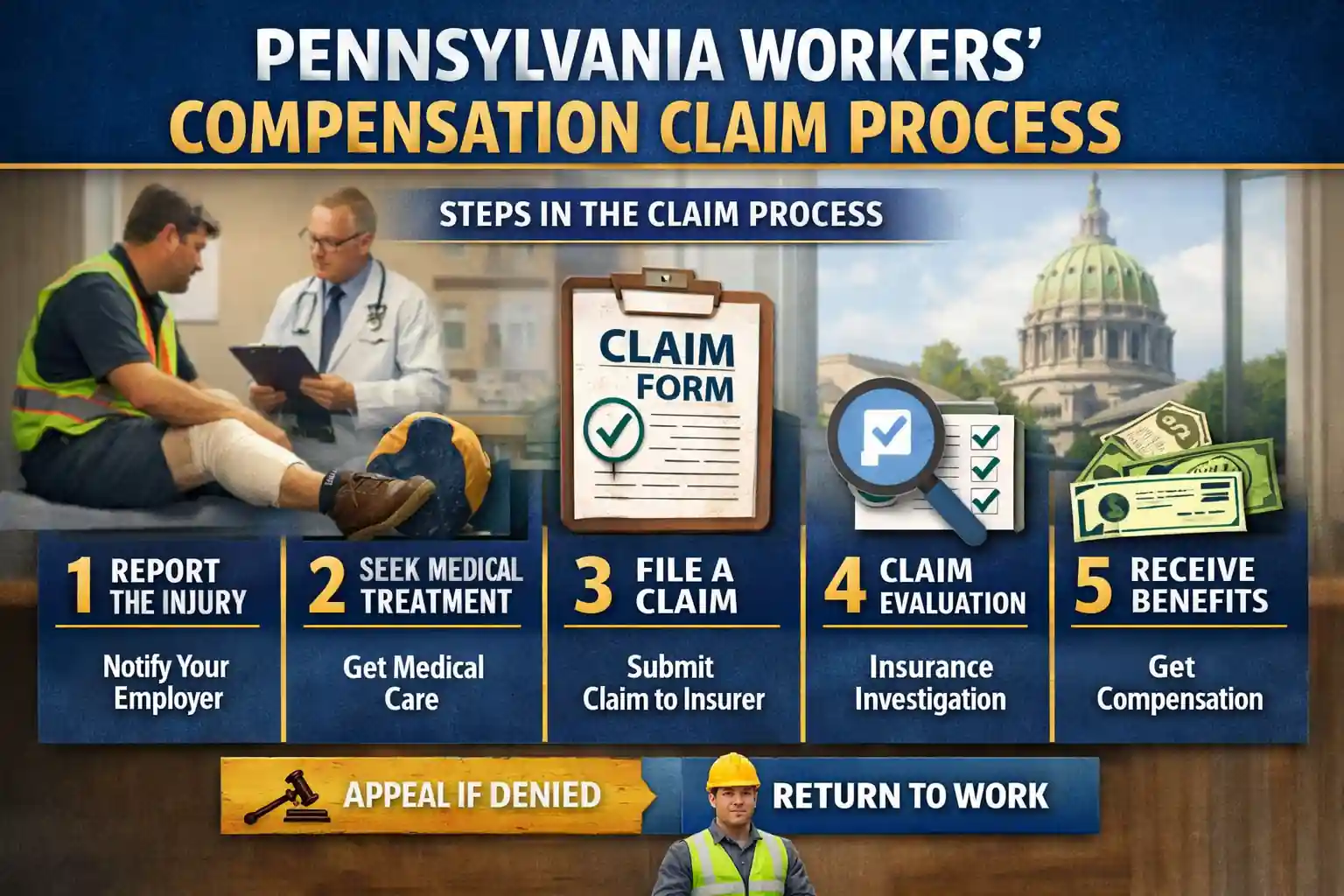
The Pennsylvania workers compensation claim process follows a predictable path, though the experience can vary wildly depending on your employer and their insurance company. Let me break down the typical journey from injury to benefits.
The 7 Stages of a Pennsylvania Workers Comp Claim
- Stage 1 – Injury Occurs: You are hurt at work or develop an occupational illness.
- Stage 2 – Report to Employer: Notify your supervisor immediately (legally required within 120 days).
- Stage 3 – Seek Medical Treatment: Visit an approved provider from your employer’s panel (first 90 days).
- Stage 4 – Employer Reports to Insurer: Your employer files a First Report of Injury with their carrier.
- Stage 5 – Claim Decision: The insurer accepts or denies your claim within 21 days.
- Stage 6 – Benefits Begin: If accepted, wage loss and medical benefits start flowing.
- Stage 7 – Resolution: Claim ends when you return to work, reach maximum medical improvement, or settle.
According to the Pennsylvania Department of Labor and Industry, over 200,000 workplace injuries are reported in the Commonwealth each year. Approximately 70% of claims are accepted without dispute. However, the remaining 30% face delays, denials, or underpayment—which is why understanding your rights is so critical.
If you are a business owner trying to understand your obligations, our article on workers compensation costs by state can help you budget appropriately.
How to File a Workers Comp Claim in Pennsylvania: Step-by-Step
When I work with injured clients, the first thing I tell them is this: documentation is everything. The workers compensation system is adversarial by nature. Insurance companies make money by paying out less. Your job is to build an airtight case from day one.

Here is the exact process for how to file a workers comp claim in Pennsylvania:
Step 1: Report the Injury Immediately
Tell your supervisor or HR department as soon as the injury happens. Pennsylvania law requires you to report within 120 days, but I strongly advise reporting within 24 hours. Delays create suspicion. I once worked with a warehouse worker in Harrisburg who waited three weeks to report a back injury because he thought it would “heal on its own.” By the time he filed, the insurance company argued the injury happened at home. He spent eight months fighting for benefits he should have received automatically.
Step 2: Get Everything in Writing
After verbally reporting, follow up with a written notice. Email works perfectly—it creates a timestamp. Include the date, time, location, and description of the injury. Keep a copy for your records. Under Pennsylvania law, your employer must provide you with written information about workers compensation, including the name of their insurance carrier and a list of approved medical providers.
Step 3: Seek Medical Treatment from the Panel
This is where many claims go wrong. In Pennsylvania, for the first 90 days after your injury, you must treat with a healthcare provider from your employer’s designated list (if they have one with at least six providers). If you see an outside doctor during this period, you may have to pay out of pocket. After 90 days, you can switch to any licensed provider. Always tell the doctor that your injury is work-related so they code the visit correctly.
Step 4: Cooperate with the Investigation
The insurance company will investigate your claim. They may request medical records, interview witnesses, or even conduct surveillance. Cooperate, but be careful. Do not give recorded statements without consulting an attorney first. Anything you say can and will be used to minimize your benefits. I have seen insurance adjusters ask leading questions designed to make injuries sound pre-existing.
Step 5: Receive the Notice of Compensation Payable or Denial
Within 21 days of your employer learning of the injury, the insurance company must either accept the claim (by issuing a Notice of Compensation Payable) or deny it. If they need more time to investigate, they can issue a Notice of Temporary Compensation Payable, which provides benefits for up to 90 days while they decide. Pay attention to the documents you receive—some contain deadlines that, if missed, can hurt your case.
Understanding how to file a workers comp claim in Pennsylvania is just the first battle. The real challenge often comes in ensuring you receive every dollar you deserve. For more on protecting your income during recovery, see our guide on disability insurance options for workers.
Pennsylvania Workers Comp Filing Requirements: What You Need to Know
The Pennsylvania workers comp filing requirements are governed by the Pennsylvania Workers Compensation Act, which has been amended numerous times since its original passage in 1915. Here are the essential requirements you must meet:
Eligibility Requirements
| Requirement | Details |
|---|---|
| Employment Status | You must be an employee (not an independent contractor). Pennsylvania uses an economic reality test to determine status. |
| Employer Coverage | Nearly all Pennsylvania employers must carry workers comp insurance. Exceptions include some agricultural workers and domestic servants working fewer than 40 hours per week. |
| Work-Related Injury | The injury must arise in the course of employment. This includes injuries at the workplace, during work travel, or while performing job duties off-site. |
| Timely Reporting | Notify employer within 120 days; file formal claim petition within 3 years if disputed. |
Covered Injuries Under Pennsylvania Law
The Pennsylvania workers comp filing requirements cover a wide range of injuries and illnesses, including:
- Traumatic injuries (falls, cuts, fractures, burns)
- Repetitive stress injuries (carpal tunnel syndrome, tendinitis)
- Occupational diseases (asbestosis, hearing loss, lung disease)
- Aggravation of pre-existing conditions caused by work
- Mental injuries caused by abnormal working conditions (limited circumstances)
- COVID-19 (for certain frontline workers under specific conditions)
One thing that surprises many workers: you can file a claim even if the injury was partially your fault. Pennsylvania’s no-fault system means that even if you tripped over your own shoelaces, you are still entitled to benefits as long as the accident occurred during work. The only exceptions are injuries caused by intoxication, intentional self-harm, or violation of the law.
According to the Occupational Safety and Health Administration (OSHA), workers have the right to a safe workplace, and filing a workers comp claim is protected activity. Your employer cannot legally punish you for exercising this right.
If you are an employer seeking to understand your coverage requirements, our article on small business insurance basics provides a comprehensive overview.
PA Workers Compensation Benefits: What You Can Expect to Receive
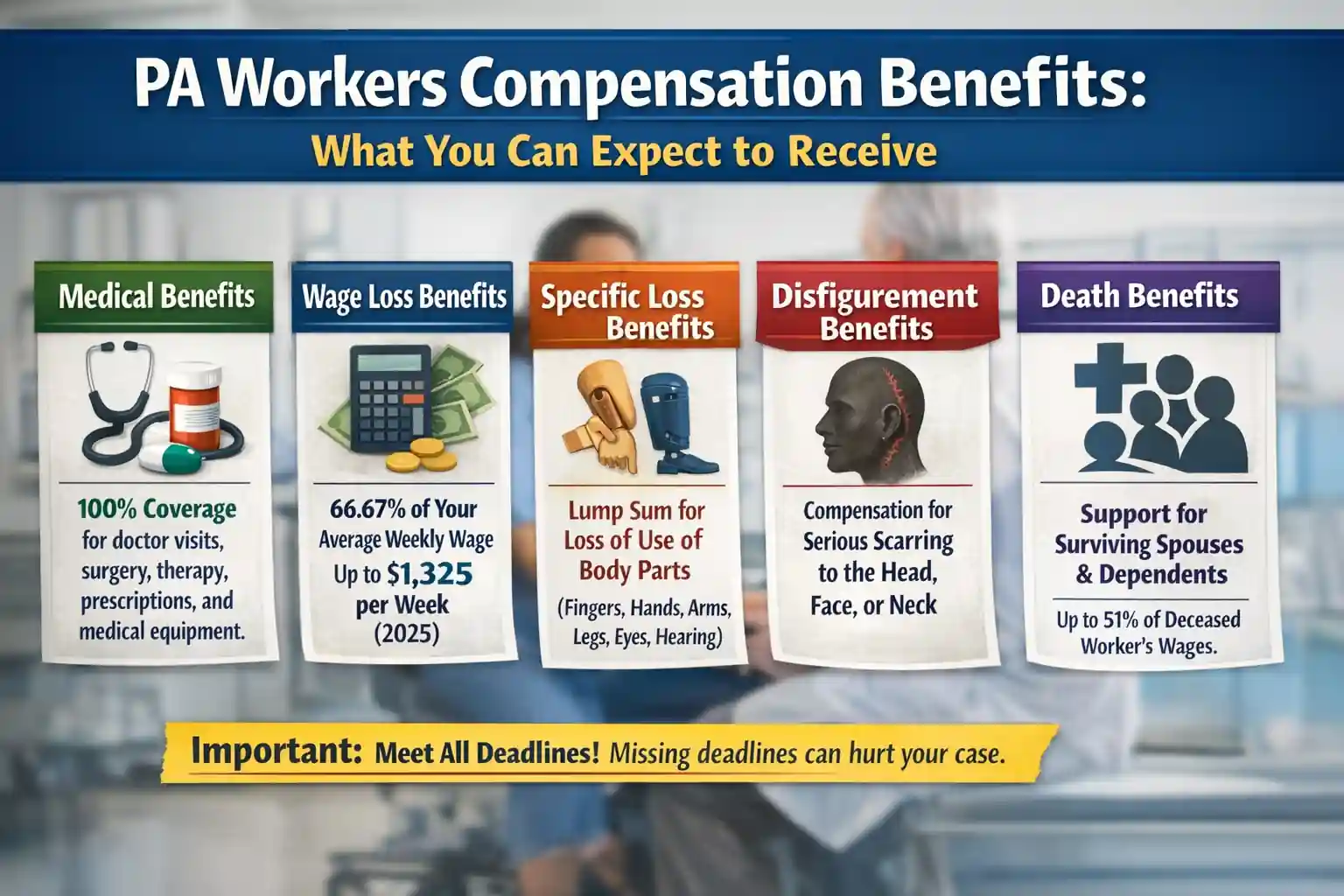
Understanding your PA workers compensation benefits is essential for financial planning during recovery. Pennsylvania offers several categories of benefits, each designed to address different aspects of your injury.
Types of PA Workers Compensation Benefits
- Medical Benefits: 100% coverage for all reasonable and necessary medical treatment related to your injury. This includes doctor visits, surgery, physical therapy, prescription medications, and medical equipment. There are no copays or deductibles.
- Wage Loss Benefits: If you cannot work, you receive approximately 66.67% of your pre-injury average weekly wage, subject to a statewide maximum (currently around $1,325 per week for 2025).
- Specific Loss Benefits: A lump sum payment for permanent loss or loss of use of body parts (fingers, toes, hands, arms, legs, eyes, hearing).
- Disfigurement Benefits: Compensation for serious and permanent scarring to the head, face, or neck.
- Death Benefits: Surviving spouses and dependents can receive weekly benefits (up to 51% of the deceased worker’s wages for a spouse, more if there are children).
Calculating Your Wage Loss Benefits
Let me give you a real example. Last year, I worked with a construction worker from Reading named Carlos. He earned $1,200 per week before his injury. Under PA workers compensation benefits rules, his compensation rate was calculated as follows:
$1,200 (Average Weekly Wage) x 66.67% = $800.04 per week
Carlos received this amount tax-free every week for the eight months he was unable to work. Additionally, all of his surgeries, physical therapy sessions, and medications were covered at no cost to him.
Understanding the Three Types of Disability Status
Your benefit amount also depends on your disability classification:
| Disability Type | Definition | Duration |
|---|---|---|
| Total Disability | You cannot work at all due to your injury. | Up to 500 weeks (with exceptions for permanent cases). |
| Partial Disability | You can work, but earn less than before due to restrictions. | Up to 500 weeks. |
| Specific Loss | Permanent loss of a body part or function. | Lump sum based on a statutory schedule. |
My brother Danny, whom I mentioned earlier, ultimately received specific loss benefits for his two fingers. Under Pennsylvania’s schedule, the loss of a thumb is worth 100 weeks of compensation, while each finger is worth 38 weeks. It is a strange feeling, seeing body parts reduced to numbers on a chart, but these benefits provided critical financial support during his recovery.
For workers concerned about long-term income protection, we also recommend reviewing our article on long-term disability coverage options.
Critical Deadlines in the Pennsylvania Workers Compensation Claim Process
Missing a deadline in the Pennsylvania workers compensation claim process can destroy your case. I cannot stress this enough. Here are the dates you must have tattooed on your brain:
Key Statutory Deadlines
- 120 Days: You must notify your employer of the injury within 120 days. Failure to do so can result in losing your right to benefits entirely.
- 21 Days: The insurance company must accept or deny your claim within 21 days of the employer’s report.
- 3 Years: If your claim is denied or ignored, you have 3 years from the date of injury to file a formal Claim Petition.
- 90 Days: You must use your employer’s designated medical providers for the first 90 days (if a valid panel exists).
- 60 Days: If you receive a Notice of Ability to Return to Work, you may need to respond within 60 days to avoid benefit suspension.
I worked with a nurse in Erie last year who learned about these deadlines the hard way. She developed carpal tunnel syndrome from years of charting and patient care. By the time she connected her symptoms to work, she was already past the 120-day notice period for when the symptoms first appeared. Fortunately, Pennsylvania courts recognize that occupational diseases can have different notice triggers—the clock starts when you knew or should have known the injury was work-related. We were able to save her claim, but it required months of legal wrangling that could have been avoided with earlier action.
What to Do When Your Pennsylvania Workers Comp Claim Is Denied
Claim denials happen more often than you might expect. According to the National Council on Compensation Insurance (NCCI), approximately 7% of workers compensation claims are initially denied nationwide, though the rate varies by state and insurer. In Pennsylvania, common reasons for denial include:
- The insurer claims the injury did not occur at work
- Insufficient medical evidence linking the injury to employment
- Pre-existing condition defense (claiming the injury existed before employment)
- Missed reporting deadlines
- Allegations of fraud or misrepresentation
If your claim is denied, do not panic. You have options. The formal appeals process involves filing a Claim Petition with the Pennsylvania Bureau of Workers Compensation. Your case will be assigned to a Workers Compensation Judge (WCJ) who will hold hearings, review evidence, and issue a decision. This process can take 12-18 months, which is why having a workers compensation lawyer Pennsylvania in your corner is so valuable.
For more on handling insurance disputes, see our article on how to appeal denied insurance claims.
When to Hire a Workers Compensation Lawyer Pennsylvania
Not every workers comp case requires an attorney. If you suffer a minor injury, your employer accepts the claim, and you return to work quickly, you may be able to navigate the system on your own. However, there are situations where hiring a workers compensation lawyer Pennsylvania becomes essential.
You Need an Attorney If…
- Your claim has been denied or disputed
- You are offered a settlement and do not know if it is fair
- Your employer retaliates against you for filing
- You have a pre-existing condition that complicates your case
- Your injury is severe or permanent
- The insurance company sends you to an Independent Medical Examination (IME)
- You are asked to give a recorded statement
- Your benefits are being terminated or reduced
How Attorney Fees Work in Pennsylvania
Here is the good news: you do not need money upfront to hire a workers comp attorney in Pennsylvania. All reputable attorneys work on a contingency fee basis, meaning they only get paid if you win. The standard fee is 20% of your recovered benefits, and this must be approved by a Workers Compensation Judge. If you are receiving $500 per week in benefits and your attorney helps you recover a $50,000 lump sum settlement, their fee would be $10,000.
I often tell injured workers: the insurance company has lawyers. They have claims adjusters with decades of experience. They have doctors on their payroll ready to testify that you are fine. You deserve someone in your corner who knows the game.
The American Bar Association offers a lawyer referral service if you need help finding a qualified attorney in your area. You can also check the Pennsylvania Bar Association for local resources.
For additional legal considerations in protecting your business, review our article on professional liability insurance coverage.
Frequently Asked Questions About Pennsylvania Workers Compensation
How long do I have to file a workers compensation claim in Pennsylvania?
You must notify your employer within 120 days of the injury. If your claim is denied or your employer fails to report it, you have 3 years from the date of injury to file a formal Claim Petition with the Bureau of Workers Compensation. For occupational diseases, the 3-year clock starts when you knew or should have known the condition was work-related.
Can I choose my own doctor for a workers comp injury in PA?
For the first 90 days, you must treat with a provider from your employer’s designated panel (if one exists with at least 6 providers). After 90 days, you are free to choose any licensed healthcare provider. If your employer does not have a valid panel, you can choose your own doctor from day one.
Are workers compensation benefits taxable in Pennsylvania?
No. Workers compensation benefits are not subject to federal income tax or Pennsylvania state income tax. This is one of the few silver linings of the system—the 66.67% wage replacement rate is effectively higher than it appears because you keep every dollar.
Can I be fired for filing a workers compensation claim?
No. Pennsylvania law protects workers from retaliation for filing legitimate claims. However, Pennsylvania is an at-will employment state, meaning employers can terminate employees for other reasons. If you believe you were fired specifically because of your claim, consult an attorney about a potential wrongful termination lawsuit.
What happens if my employer does not have workers compensation insurance?
Failing to carry workers compensation insurance is a crime in Pennsylvania. If your employer is uninsured, you can file a claim with the Pennsylvania Uninsured Employers Guaranty Fund (UEGF), which will pay your benefits and then pursue your employer for reimbursement. You may also have the right to sue your employer directly in civil court.
Final Thoughts: Protecting Your Rights After a Workplace Injury
Navigating the Pennsylvania workers compensation claim process is not easy. The system is complex, adversarial, and often seems designed to wear you down. But remember: these benefits exist because generations of workers fought for them. You paid for this protection with every hour you worked. Do not let anyone—not your employer, not the insurance company, not anyone—convince you that you do not deserve what you are owed.
If I have learned anything from watching my brother’s journey and helping hundreds of injured workers since then, it is this: the workers who succeed are the ones who document everything, act quickly, and are not afraid to ask for help. Whether you handle your claim yourself or hire a workers compensation lawyer Pennsylvania to fight for you, knowledge is your greatest weapon.
Stay safe out there. And if you do get hurt, know that you have rights—and people ready to help you exercise them.
Injured at Work in Pennsylvania? Know Your Rights.
The Pennsylvania workers compensation claim process begins the moment you are hurt. Report immediately, document everything, and do not sign anything without understanding your rights. For more information, visit the Pennsylvania Bureau of Workers Compensation.
About the Author
Michael Torres is a Workers Compensation Claims Specialist with over 12 years of experience helping injured workers in Pennsylvania. After witnessing his brother’s difficult journey through the workers comp system, Michael dedicated his career to advocating for fair treatment of injured employees.
Michael is certified by the Pennsylvania Bureau of Workers Compensation and is a member of the Workers Injury Law and Advocacy Group (WILG). He has assisted in the successful resolution of over 800 workers compensation claims across Pennsylvania.
Connect with Michael on LinkedIn or visit the Pennsylvania Department of Labor and Industry for official resources.


