Updated: January 26, 2025 | by Robert Mitchell, Licensed Life Insurance Specialist | Reading Time: 15 minutes
Quick Answer: Life insurance for high risk occupations rates typically run 25% to 200% higher than standard policies, with some hazardous professions facing even steeper premiums. According to the Bureau of Labor Statistics, certain occupations carry significantly elevated mortality risks, which insurers factor into their pricing. However, coverage is absolutely available—and often more affordable than workers expect. The key is shopping with multiple insurers, as rates vary dramatically, and working with agents who specialize in high-risk coverage.
Why Life Insurance for High Risk Occupations Rates Became Personal for Our Family
My brother-in-law Jake worked as a commercial roofer in Phoenix for fifteen years. Every Thanksgiving, he’d show us pictures from job sites—standing on steep slopes, working in 115-degree heat, sometimes six stories above the ground. We’d joke nervously about his “crazy job,” but he always brushed off our concerns. “I’m careful,” he’d say. “Nothing’s gonna happen to me.”
Then something did happen. Not to Jake, thank God, but to his coworker and close friend Miguel. A fall from a commercial building left Miguel’s wife and three kids without a father—and without any life insurance. Jake came home that night and told my sister they needed to get serious about coverage. When he started shopping, the first quote he got made him sick: $380 a month for $500,000 in coverage. That’s when he called me.
What I discovered, helping Jake navigate life insurance for high risk occupations rates changed my entire perspective on this industry. Rates varied wildly between companies—from that shocking $380 down to $147 monthly for identical coverage. Some insurers classified roofing as “ultra-hazardous,” while others called it merely “elevated risk.” The difference in terminology translates to thousands of dollars annually.
According to the Occupational Safety and Health Administration, over 5,000 workers die from workplace injuries each year in America. Behind every statistic is a family that needed—and hopefully had—life insurance protection. This guide shares everything I’ve learned about finding affordable coverage for those who work the jobs most of us would never consider.
For foundational coverage information, explore our comprehensive guide to life insurance basics.
Understanding Life Insurance for High Risk Occupations Rates
Life insurance for high risk occupations rates are determined by actuarial data showing increased mortality risk in certain professions. Insurance companies analyze decades of claims data, workplace fatality statistics, and injury rates to calculate appropriate premiums. But here’s what surprises most people: the way different insurers interpret that data varies enormously.
One company might view a firefighter as a moderate risk worthy of a 50% rate increase, while another sees the same firefighter as high risk requiring 150% higher premiums. This variation is exactly why shopping around matters so much when dealing with life insurance for high risk occupations rates.
Factors Affecting Life Insurance for High Risk Occupations Rates
- Occupation classification: How the insurer categorizes your specific job
- Daily job duties: Actual tasks performed, not just job title
- Safety protocols: Employer safety programs and equipment provided
- Industry experience: Years in the profession may lower perceived risk
- Training and certifications: Specialized safety credentials can help
- Personal health: Overall health factors still apply
- Coverage amount: Higher face values may face stricter underwriting
According to LIMRA research, the life insurance industry has become increasingly sophisticated in occupational risk assessment, with many companies developing specialized underwriting guidelines for hazardous professions.
The Insurance Information Institute notes that despite higher rates, most high-risk workers can obtain coverage—the question is finding the right insurer and optimal policy structure.
When my neighbor Carlos transitioned from office work to become a lineman for the power company, he was stunned when his existing insurer wanted to more than double his premium at renewal. His job title had changed, triggering automatic reclassification. We shopped his policy to six different companies and found one that viewed utility linemen more favorably—saving him $1,800 annually.
High Risk Life Insurance Rates: What Different Occupations Actually Pay
High risk life insurance rates vary significantly by profession, with some jobs facing modest increases and others seeing premiums three or four times standard rates. Understanding where your occupation falls on this spectrum helps set realistic expectations.
High Risk Life Insurance Rates by Occupation
| Occupation | Risk Classification | Typical Rate Increase |
|---|---|---|
| Firefighter | Elevated | 25-75% |
| Police Officer | Elevated | 25-100% |
| Roofer | High | 50-150% |
| Ironworker/Steelworker | High | 75-175% |
| Commercial Pilot | Moderate to High | 25-100% |
| Oil Rig Worker | High | 100-200% |
| Logger | Very High | 150-300% |
| Commercial Fisherman | Very High | 150-300%+ |
| Underwater Welder | Extreme | 200-400% |
Real Examples of High Risk Life Insurance Rates
According to NerdWallet’s analysis of high-risk coverage, a healthy 35-year-old male in a standard occupation might pay $25 monthly for $500,000 in term coverage. That same person working as a logger could face premiums of $75-$100 monthly—still affordable, but a significant increase.
The Forbes Advisor insurance guide emphasizes that high risk life insurance rates can vary by 50% or more between insurers for the exact same applicant. This variation makes comparison shopping absolutely essential.
My college roommate became a helicopter pilot for a medical transport company. His first application—to a mainstream insurer—was declined outright. The second quoted $520 monthly for $750,000 in coverage. Through a specialized broker, he eventually found a policy at $195 monthly from a company that had extensive experience with aviation risks. Same pilot, same coverage, dramatically different high risk life insurance rates.
For more on term coverage specifics, see our complete term life insurance guide.
Life Insurance for Dangerous Jobs: Which Professions Face the Highest Premiums
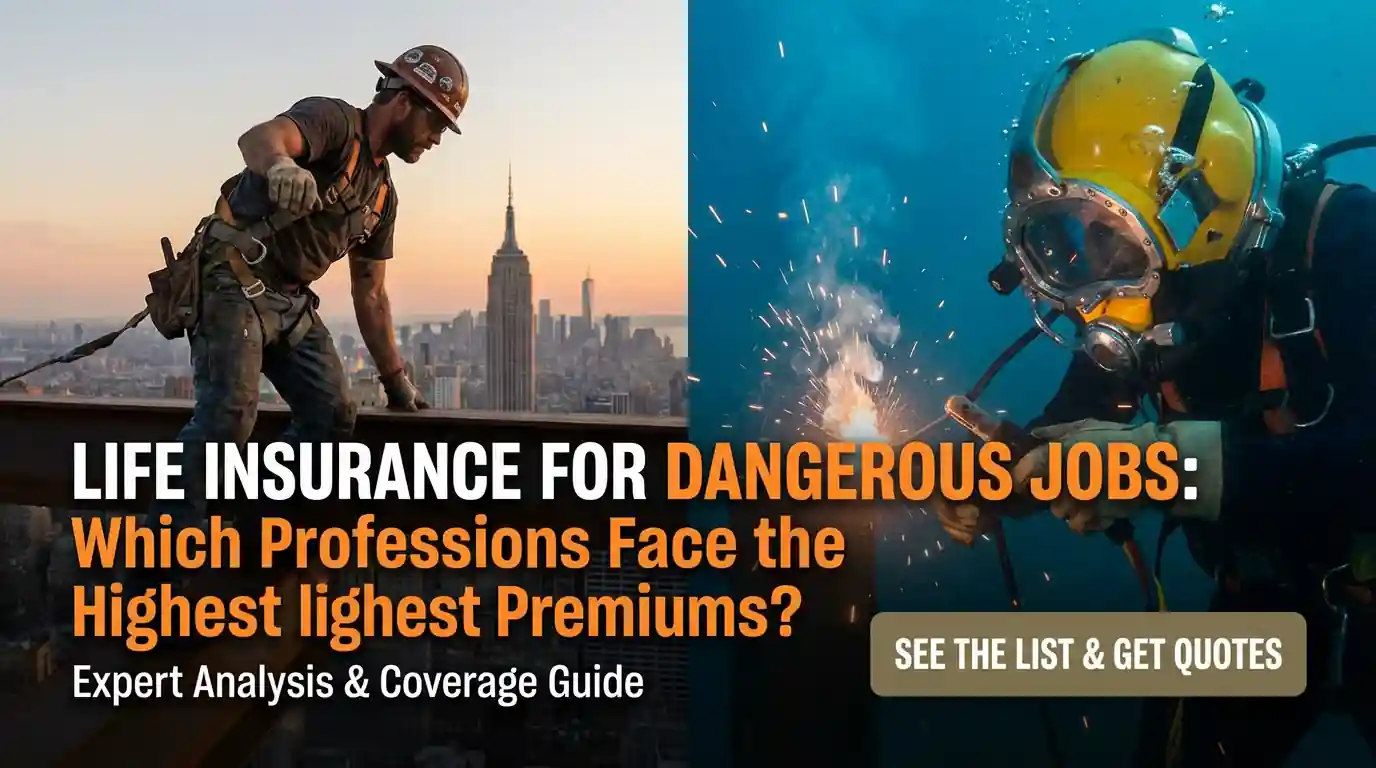
Life insurance for dangerous jobs requires understanding how insurers categorize different occupations. Not all risky-sounding jobs carry the highest premiums, and some professions you might not consider dangerous face significant rate increases.
Life Insurance for Dangerous Jobs: Occupation Categories
- Extreme Risk: Bomb disposal, combat military, professional stunt performers
- Very High Risk: Commercial fishing, logging, mining, underwater welding
- High Risk: Roofers, ironworkers, oil rig workers, private pilots
- Elevated Risk: Firefighters, police, EMTs, electrical linemen, truck drivers
- Moderate Risk: Construction workers, commercial pilots, security guards
- Standard Risk: Most office and retail occupations
According to the Bureau of Labor Statistics Census of Fatal Occupational Injuries, fishing and logging consistently rank as America’s most dangerous professions, with fatality rates many times higher than the national average. Insurers price life insurance for dangerous jobs based primarily on these mortality statistics.
The National Institute for Occupational Safety and Health provides detailed occupational hazard data that insurers use when developing their risk classifications.
The Details Matter for Life Insurance for Dangerous Jobs
When applying for life insurance for dangerous jobs, specifics matter enormously. Two people with the same job title can receive completely different rate classifications based on their actual duties.
I learned this firsthand when helping a friend who worked in the oil and gas industry. His official title was “field technician,” but his actual job involved monitoring equipment from a trailer—he rarely went near the rigs themselves. The first agent coded him as an oil rig worker, triggering huge premiums. When we clarified his actual duties, his classification changed to standard risk and his premium dropped by 60%.
For information on coverage amounts, explore our guide to calculating life insurance needs.
Affordable Life Insurance for High Risk Workers: Strategies That Work
Finding affordable life insurance for high risk workers requires a strategic approach. The good news is that with the right tactics, most workers in hazardous occupations can find reasonably priced coverage—even if the first quote seems impossibly expensive.
How to Find Affordable Life Insurance for High Risk Workers
- Shop with at least 5-7 insurers: Rate variation is dramatic for high-risk occupations
- Work with specialized brokers: Some agents focus exclusively on high-risk cases
- Maximize employer coverage first: Group rates avoid individual underwriting
- Consider graded benefit policies: Easier approval with graduated death benefits
- Layer multiple smaller policies: May be easier than one large policy
- Improve controllable factors: Health, fitness, smoking status
- Document safety certifications: OSHA training, specialized credentials
- Time applications strategically: Apply during desk-work periods if possible
According to Policygenius research on high-risk coverage, the difference between the cheapest and most expensive quotes for identical high-risk applicants can exceed 100%. This makes shopping around the single most effective strategy for finding affordable life insurance for high risk workers.
The Consumer Reports insurance buying guide recommends working with independent brokers who represent multiple carriers when seeking affordable life insurance for high risk workers, as they can quickly identify which companies offer the most favorable rates for specific occupations.
The Power of Employer Coverage
My brother-in-law Jake ultimately found his best affordable life insurance for high risk workers solution through a combination approach. His roofing company offered group life insurance at 1.5x his salary with no individual underwriting—about $90,000 in coverage. He supplemented this with a personal $400,000 policy from a company that specialized in construction trades. His total monthly cost was $167, compared to the original $380 quote from a mainstream insurer.
Occupational Life Insurance Coverage: Special Programs and Benefits
Occupational life insurance coverage refers to specialized programs designed specifically for workers in hazardous industries. These programs often provide more favorable terms than standard retail policies because they’re built around the unique risk profiles of specific professions.
Occupational Life Insurance Coverage Sources
| Coverage Source | Benefits | Limitations |
|---|---|---|
| Employer Group Plans | No individual underwriting, low cost | Ends when job ends, limited amounts |
| Union Benefits | Negotiated rates, portable between jobs | Requires union membership |
| Professional Associations | Group rates for members | Coverage may still require underwriting |
| Specialty Insurers | Expertise in specific industries | May have limited policy options |
| Accidental Death Policies | Easier approval, lower premiums | Only covers accidental death |
According to the Department of Labor, many employers in hazardous industries provide occupational life insurance coverage as a standard benefit, recognizing the challenges their workers face in obtaining individual coverage.
The Society for Human Resource Management reports that employers in high-risk industries increasingly offer robust occupational life insurance coverage as a recruitment and retention tool.
Union and Association Benefits
When my friend Marcus became an ironworker, he immediately joined the local union—and not just for the job benefits. The union’s occupational life insurance coverage provided $150,000 in death benefits at a fraction of what he’d pay individually. Many professional associations offer similar group rate programs that can substantially reduce life insurance for high risk occupations.
For understanding different policy types, see our comparison of term vs whole life insurance.
Best Life Insurance for Hazardous Occupations: Top Companies for 2025
Finding the best life insurance for hazardous occupations means identifying companies that specialize in high-risk underwriting and offer competitive rates for specific dangerous professions. Not all insurers are created equal when it comes to rating workers in hazardous jobs.
Best Life Insurance for Hazardous Occupations: Company Comparison
| Company | Best For | Key Advantage |
|---|---|---|
| Prudential | General high-risk occupations | Flexible underwriting guidelines |
| Protective Life | Construction trades | Favorable construction classifications |
| Lincoln Financial | Aviation professionals | Specialized pilot underwriting |
| Mutual of Omaha | Emergency responders | First responder programs |
| Principal Financial | Oil and gas workers | Energy industry expertise |
| Transamerica | General hazardous occupations | Broad risk appetite |
According to AM Best insurance ratings, all companies offering the best life insurance for hazardous occupations should carry strong financial stability ratings. Checking ratings before purchasing ensures the company can pay claims when needed.
The National Association of Insurance Commissioners provides consumer resources for researching insurance company complaints and financial stability before purchasing the best life insurance for hazardous occupations.
Important: The best life insurance for hazardous occupations varies based on your specific job. A company that’s excellent for firefighters might not be the best choice for commercial fishermen. Working with a broker who can submit applications to multiple carriers simultaneously is often the most efficient approach.
For company comparisons, see our guide to the best life insurance companies.
Strategies to Lower Your Life Insurance for High Risk Occupations Rates
Even with a hazardous job, you can take steps to reduce your life insurance for high risk occupations rates. Some factors are within your control, and optimizing them can make meaningful differences in your premiums.
Proven Strategies to Reduce Life Insurance for High Risk Occupations Rates
- Optimize your health: Excellent health can partially offset occupational risk factors
- Quit smoking: Smoking doubles or triples premiums on top of occupational increases
- Document safety training: Provide certificates for OSHA, industry-specific safety courses
- Highlight experience: Years without workplace incidents demonstrates lower individual risk
- Describe duties accurately: Ensure your actual work is properly classified
- Consider term over whole life: Term insurance is significantly cheaper
- Choose higher deductibles: If available, higher deductibles lower premiums
- Apply during safer periods: If your work is seasonal, apply during off-seasons
According to Bankrate’s high-risk insurance analysis, maintaining excellent health can offset 25-50% of the occupational risk premium increase. A healthy ironworker may pay less than an unhealthy office worker in some cases.
The Investopedia guide to underwriting explains how insurers weigh multiple factors together, meaning strength in some areas can compensate for weaknesses in others.
The Health Factor
My cousin works as a commercial diver—one of the most dangerous jobs in America. When he first applied for coverage, his life insurance for high risk occupations rates were astronomical. But he’s also in exceptional physical condition (the job demands it), doesn’t smoke, and has perfect blood pressure. By applying to companies that weight health heavily in their underwriting, he found a policy that was expensive but not unaffordable—$215 monthly for $500,000 in coverage.
For health optimization tips, explore our guide to improving your life insurance rates.
Frequently Asked Questions About Life Insurance for High Risk Occupations Rates
Can I be denied life insurance because of my job?
Yes, some insurers decline coverage for extremely hazardous occupations like bomb disposal or active combat military roles. However, most high-risk workers can find coverage through specialized insurers or guaranteed issue policies. If one company declines, keep shopping—another may have different underwriting guidelines.
What happens if I change to a less dangerous job after getting insurance?
Most policies are priced based on your occupation at application time. If you later switch to a safer job, contact your insurer—many will reduce your premiums based on the occupational change. This is called a “reclass” and can result in significant savings. Always notify your insurer of job changes.
Does my policy still pay if I die during work?
If your occupation was disclosed during application and the policy was issued, yes—deaths during work are covered. However, if you misrepresented your occupation or changed to a more dangerous job without notification, claims may be denied. Always be truthful about your work during the application process.
Should I get life insurance through my employer or buy my own?
Ideally, both. Employer coverage is often cheaper because it avoids individual underwriting, but it ends when you leave the job. Personal coverage is portable and stays with you regardless of employment changes. Most advisors recommend maximizing employer coverage and supplementing with a personal policy for comprehensive protection.
Are accidental death policies a good alternative for high-risk workers?
Accidental death and dismemberment (AD&D) policies are easier to obtain and cheaper for high-risk workers, but they only pay for accidental deaths—not illness or natural causes. They can be a useful supplement to traditional life insurance but shouldn’t be your only coverage. Consider AD&D as an additional layer, not a replacement.
How do I find a broker who specializes in high-risk occupations?
Search for “high-risk life insurance broker” or “impaired risk life insurance agent” in your area. Independent brokers who work with multiple carriers are typically better for high-risk cases than captive agents. Ask specifically about their experience with your industry and request references from other clients in similar occupations.
Protecting Your Family Despite the Risks
Working in a dangerous occupation doesn’t mean your family should be left unprotected. Yes, life insurance for high risk occupations rates are higher than standard premiums—but coverage exists, and it’s often more affordable than you might expect when you know where to look.
I think about Jake and his roofing crew often. After Miguel’s death, every worker on that team got serious about life insurance. Some pay more than their colleagues in safe office jobs, but they all have coverage now. Their families won’t face financial devastation on top of grief if the worst happens.
Your job may be dangerous, but leaving your family unprotected is the biggest risk of all. Take the time to shop around, work with specialized brokers, maximize employer coverage, and find the policy that fits your budget. The workers who keep America running—building our structures, protecting our communities, harvesting our resources—deserve affordable access to life insurance protection.
Ready to Find Coverage for Your High-Risk Occupation?
Don’t let fear of high premiums leave your family unprotected. Life insurance for high risk occupations rates vary dramatically between insurers—the right company can make coverage affordable. Start comparing quotes today and secure the protection your loved ones deserve.
About the Author
Robert Mitchell is a licensed life insurance specialist with over 20 years of experience helping workers in high-risk occupations find affordable coverage. Based in Houston, Texas, he has particular expertise in construction, oil and gas, and first responder insurance needs.
Robert holds life insurance licenses in 28 states and is a member of the National Association of Insurance and Financial Advisors (NAIFA). His interest in high-risk coverage began when his brother-in-law, a commercial roofer, struggled to find affordable protection.
Connect with Robert on LinkedIn or visit the NAIC Consumer Resources for official insurance information.
Life Insurance for High Risk Occupations: Action Checklist
- Document your exact job duties, not just your title
- Gather safety certifications and training records
- Check your employer’s group life insurance benefits
- Research union or professional association coverage options
- Get quotes from at least 5-7 different insurers
- Work with a broker who specializes in high-risk occupations
- Consider layering employer coverage with personal policies
- Optimize health factors you can control (weight, blood pressure, smoking)